Showing posts with label history. Show all posts

Wednesday, March 12, 2014

Visiting the Staffordshire Hoard

Looking along the table where the entire hoard was laid out -
in the foreground are its 86 sword pommels, with other sword
fittings behind, followed by decorative and religious items.
Sometimes being a journalist is a real boon for this little history nerd, getting me access to places I would never normally see. Until recently the pinnacle of this was being invited to attend the press conference where they announced that the human remains excavated from beneath a Leicester carpark in 2012 were those of Richard III, 'beyond reasonable doubt'.

But last week I experienced something that, for an Early Medievalist, was even more exciting: a top-secret trip to Birmingham Museum and Art Gallery to see the Staffordshire Hoard, England's largest collection of Anglo-Saxon metalwork, assembled in one place for the first time since its initial discovery in 2009.

Why, if it was that exciting, am I blogging a week after events? Because until today we few journos, we happy few, who had been summoned to come and see the hoard, had been under strict embargo - such were the security concerns surrounding this unique group of objects that we were forbidden from breathing a word about it until it was safely split up among its normal four homes once more.

An astonishing assemblage
The hoard had been temporarily reunited for a major research project, allowing Anglo-Saxon expert Chris Fern to carefully examine every piece and group together matching fragments, and sword fittings that belonged to the same weapon - and as a single collection, spread out across a black tablecloth, the newly-cleaned and conserved pieces of gold and silver were an astonishing sight. It was actually rather moving to see this extraordinary assemblage with my own eyes, having read so much about it - though less than helpful to be struck speechless at a press conference!

Experts have now
matched sword fittings
from the same weapon
Piecing together the hoard physically has allowed researchers to begin to piece together its meaning, and a wealth of new information has already emerged - we now know that the items were collected over a period of some decades, and that they were probably made in a number of different regions of Britain. This helps to narrow down the hoard's purpose.

The enigmatic 'Mystery Object'. Now
reassembled, the jury is still out on
the intended purpose of this item.
Since its discovery, three main theories have been debated: that it was the war chest of a powerful Mercian chieftain; that it is a spectacular votive offering; or, less likely, that it represents the wares of a virtuosic but ill-fated artisan who stashed his stock for safekeeping but was unable to return to reclaim it later. Now it appears that these items, mostly made up of sword fittings roughly stripped from the weapons they adorned, were plunder, gathered from multiple battles with multiple peoples.

Decorative mount shaped like a bird of prey
What has also become evident, now the items have all been painstakingly cleaned (a delicate task; conservators have been using natural thorns instead of metal tools, to avoid damaging the soft gold), is the extraordinary artistic skill of their creators. Garnets barely 3mm across have been shaped into delicate curves, while some items are decorated with filigree (metal wires soldered onto a plate base) curls so fine that three of them are still not quite the length of a grain of rice.

Sword pyramid, boasting delicately
carved garnets barely 3mm in diameter
There is much still to find out about the hoard, but it is extremely exciting to see its secrets beginning to emerge - and even more so to hear about these developments in person. I'd reckoned on being at the museum for an hour... almost three passed before I could tear myself away.

The hoard team have a fab website here, with lots of photographs, as well as blogs and videos giving behind the scenes insights into their work. You can find out more about visiting the hoard here.

All images copyright Birmingham Museums Trust

Monday, March 3, 2014

Into Parliament I shall go!

 It never hurts to have friends in high places, and today I took advantage of a rare Monday off to visit a friend who works in the House of Lords. Having lived in London for the best part of 4 years the Palace of Westminster is a pretty familiar sight, but shamefully I'd never made it inside. Until today.

Getting into the Lords is a bit like getting into departures at an airport - security scans for me, and a trip through an x-ray machine for my satchel. I also had to wear the most unflattering photo ID I've ever had the pleasure of hanging round my neck for the day - I was talking at the time it was taken, so I can't say I was unhappy that at the end of the day I had to surrender that gormless portrait at the gate rather than keep it as a souvenir.

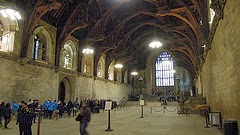
Westminster Hall
Image: David McKelvey
From there our tour started, rather unexpectedly, with a trip through the service passageways and carparks - with a bit of impromptu Prescott-spotting en route. There are some fab things to see even in this more mundane environment, though: fixed to on one concrete pillar is a plaque marking where Guy Fawkes was apprehended in his attempt to blow up Parliament, while the sight of a sign marking two parking spaces as 'Peers' motorcycles only' is always good for a giggle.

From there we made our way into Westminster Hall, the oldest building in the complex: a cavernous stone space with a soaring Medieval timber roof and a veritable floor of brass plaques marking historic events. It's an inspiring sight - and also home to both the palace's gift shop, and home to what I'm told is a beautiful crypt, though it wasn't open on the day we visited.

House of Commons
The palace itself is a bewildering warren of corridors, though you can always tell when you have strayed from Commons into Lords or vice-versa due to the strict colour-coding; should the carpet or furnishings switch abruptly from red to green, you know you've wandered into the other territory. Along these passages are committee rooms and other official chambers, sometimes opening out into vast galleries glittering with gilded picture frames and elaborate floor tiles, their walls packed with huge murals and regal statues.

Royal Gallery
Largest of these is the Royal Gallery, which forms the main procession route for the Opening of Parliament, and often hosts addresses by visiting foreign heads of state. I understand Angela Merkel spoke there quite recently, though it was deemed politic for Nicolas Sarkozy to hold his speech elsewhere, decorated as its walls are with images of British victories in the Napoleonic wars.

House of Lords
The culmination of the trip, though, was seeing the Commons and Lords chambers, decked out in green and red, the former with its ornate throne for the Speaker and (now glassed-in) public gallery, the latter home to a great red cushion or 'woolsack', for the Lord Speaker. This cushion lies in front of an even more elaborate throne, where the monarch sits during the State Opening of Parliament, and I was amused to learn that the eldest child of any serving member of the House of Lords is entitled to sit on the steps of the throne to watch proceedings in session.

Before it was time to go, I was offered the chance to get a bite to eat - and instead of one of the fancy Lords' restaurants, we opted to eat in the canteen beside the Press Gallery - I've always wanted to know what it's like to be a lobby journalist. And it turns out it's cheap and cheerful, but still much more comfortable than your average cafeteria. Very cheap, in fact; a roast lamb lunch cost less than £3. Maybe the politicians hope that well-fed journalists will write friendlier stories about them!

All images copyright UK Parliament unless otherwise stated

Monday, March 21, 2011

Bermondsey Docks and Jacob's Island

This was one of my favourite walkabouts - if you time your visit to when it's just getting dark then it is such an atmospheric place to explore. 


Just ashort walk from Bermondsey or London Bridge station, this area of London has a very colourful history. The area around the old docks used to be Victorian London's most infamous and impoverished slum, 'Jacob's Island'. Described by scandalised social reformers as 'the very capital of cholera'. It was so notorious that Charles Dickens associated it with his most famous villain, Bill Sikes, who met his end slipping from the roof of one of its wretched dwellings. 

Historic image of the slums crowding the waterways
of Jacob's Island - once one of London's most notorious areas.
Nowadays there are still lots of narrow streets with Victorian warehouses and mill buildings - though in a dramatic reversal of the area's fortunes, many of these have now been converted into frighteningly expensive apartments. 

Follow the winding roads away from the roar of Jamaica Rd and you'll find yourself at the Thames. Here you can rest your elbows on the riverfront wall and breathe in the warm smell of the foreshore mud, listening to the slow slap and hiss of the water below. 

Immediately before you are banks of houseboats joined by platforms covered with plants in an improvised garden, while in the distance this peaceful scene is overlooked by the neon glow of the City. After dark, the bridges and London landmarks are lit up in a stunning display - though this atmosphere also has a darker edge; even putting aside the area's destitute past, this was also a place of execution for pirates.