Showing posts with label church. Show all posts

Saturday, March 12, 2011

Devil's Dyke, Reach

Another week, another walkabout and controversially this one comes to you from (whisper it) outside London! Horror. 

In fact there's no mystery to it - I was out of town for a birthday party this weekend. But pace all those who would call me a skiver, we still managed to visit a couple of 'places of historical interest' en route to the pub so I'm going to write up our outing as a special Cambridgeshire walkabout.

The journey to Reach began at 9.45 as we all traipsed down to the bus station to catch the 12a at 10 o'clock. Bit of a painfully early start as we'd still been drinking Goldschläger at half 3, but the walk (and the typically arctic Cambridge temperatures) did us all good. We were meant to be ten on the bus but lost one of our number before the journey had even begun (apparently he forgot) - but after that the day went without mishaps. Speaking of the bus, top tip: if you're travelling in multiples then it's cheaper to buy a 'family ticket' of two returns rather than a day rider each.

There aren't any buses to Reach from Cambridge on a Sunday so we went via Burwell - it takes 50 minutes but it's a nice enough journey through green fields, interesting villages and the Newmarket racecourses. If you plan to do the same bear in mind they don't run often - there are only a couple of buses before lunchtime and then you've got a good 45-minute walk from Burwell to Reach. But it's well-worth an early start - the food at the pub we visited is *amazing*.

Fifty minutes later we bowled into Burwell. Now, we were only here because of a quirk of the Sunday bus timetable but it's actually an interesting place for a little wander before heading over to Reach. The 15th-century church is beautiful and well worth a visit (we popped in on the way back so I'll talk about this later) and if you head up the brilliantly-named Cuckolds Row (to the left-hand side of the bank) you come across a strange, sad little story from Burwell's past.
Photo by Hugo

In 1727 the village was holding a puppet show in a local barn. The performance had proven so popular that more people had shown up than could be accommodated by the building so (either to control numbers or to prevent people entering without paying - accounts vary) the barn door was nailed shut for the duration of the performance. This decision had tragic consequences when a lantern was knocked over - the Parish Register describes what happened next:

"At about 9 o'clock on the evening of September 8th 1727, fire broke out in a barn, in which a great number of persons were met together to see a puppet show. In the barn were a great many loads of new light straw. The barn was thatched with straw which was very dry, and the inner roof was covered with old dry cobwebs, so that the fire like lightning flew around the barn in an instant. There was but one small door, which was close nailed up, and could not easily be broken down. When it was opened, the passage was so narrow and everybody so impatient to escape that the door was presently blocked up, and most of those that did escape, which was but very few, were forced to crawl over the bodies of those that lay in a heap by the door."

Some 76 villagers lost their lives that night and two more died of their injuries within two days. Almost two thirds of these casualties were children. A round plaque on the wall of Cuckolds Row marks where the barn stood, and in the village churchyard, a little way west of the door of St Mary's, a mass grave for the victims is marked by a stone on which is carved a heart surrounded by flames.

If you head on up Cuckolds Row you quickly end up in open fields. This is actually the best way to get to Reach - you can stomp along the road if you'd prefer but going cross-country is much more fun.

Castle Moat
Just outside the village you can explore the remains of Burwell Castle. Not that there's much of it left these days - apparently the local fire brigade knocked down the last bit of wall in the 1930s when they were testing a new hosepipe! But you can still see where the moat was and some grassy mounds that were peasant cottages. The information board in the field says that these peasants were forced to destroy their homes to make way for the castle to be built. Bet they thanked their landlord for that. And after all that the castle was never even completed!

Burwell Castle dates from a period called the Anarchy. This was a 12th-century succession crisis that followed the death of Henry I. We almost had a reigning queen, Matilda, centuries before Elizabeth I, but Henry's daughter was passed over in favour of his nephew, Stephen.

Not all England's barons backed Stephen, however, and one of those who opposed him was Geoffrey de Mandeville, First Earl of Essex. Geoffrey was being a proper nuisance, setting up camp near Ely and attacking nearby towns such as Cambridge, so Stephen ordered for castles to be built around Geoffrey's base. One of these was Burwell.

Burwell Castle
The moat had been dug but the stone keep was still only partly built when Geoffrey de Mandeville was mortally wounded in battle. With his revolt crushed there was no further need for these castles and Burwell was never finished.

The Anarchy ended in 1153 when Stephen signed a treaty agreeing to recognise Matilda's son Henry Curtmantle as his heir. Stephen died the following year and Henry II went on to found the Plantagenet dynasty.

Leaving the castle behind we walked across the fields. East Anglia is wonderfully flat wherever you go but here you really noticed it, stomping along head bowed against the wind towards the one high point in the landscape - the green ridge of Devil's Dyke.

Devil's Dyke
The Dyke is an Anglo-Saxon earthwork, built in a 7.5 mile line - almost perfectly straight - through the Fens. From the base of the ditch running alongside it to the top of the ridge, parts of the dyke are over 30ft high. It is thought that it was built to defend the border between the kingdoms of Mercia and East Anglia - and since the ditch is on the west side, it was probably built by the East Anglians, in about the 5th or 6th century.

This dyke is part of a series of defensive earthworks in the area; there is also Fleam Dyke, Brent Ditch and Bran Ditch, and all of these served to defend borders, control trade and the movement of people. Devil's Dyke, however, is the largest and best-preserved of these. In fact, it is thought by archaeologists to be the finest of its kind in the whole country, and is a Scheduled Ancient Monument.

Looking along the Dyke
As for the dyke's name, the 'Devil' part is post-medieval; in the 11th century, when William the Conqueror besieged Ely, it was known simply as 'Reach Dyke'. However, the current name comes from a local legend that the Devil turned up uninvited at a wedding in Reach - when the guests chased him away his tail dug a great groove in the countryside. 

Walking along the Dyke (getting thoroughly blasted by the wind) we had a great view across the flat landscape - a wide expanse of fields. Having grown up further east, near Norwich, and then lived in Cambridge for almost five years, these bleak flatlands are very familiar to me. Large hills and mountains still startle me with their novelty! It's only a short walk before you can see the village of Reach ahead of you.

Photo by Vicky
Reach itself is a lovely village, with a wide green and some pretty houses with a plaque commemorating a charter of King John granting the inhabitants the right to hold an annual fair. In our eagerness we had made very good time and arrived at our pub at 11.45, 15 minutes before it was due to open. But the village green had a convenient bench surrounding a tree, where we could sit and admire the new bluebells and primroses just starting to come out. And it was more than worth the wait.

Just off the village green is a pub called the Dyke's End - a white building set in a small garden with a faded painted sign. Inside it is light and airy - all cream-panelled walls and pale wood frames, low lighting, wooden floor and ceiling beams. And best of all - just inside the door, a roaring open fire. We were certainly glad to see that!

The Dyke's End is a freehouse and, not being much of a beer drinker, I consulted birthday boy Hugo and ale enthusiast Jo for their verdict. Their general opinion was that the local pale ale, called (appropriately enough) 'Devil's Dyke', was 'ok , but not as good as their bitter'. But apparently the bitter is particularly good - and Paul had high praise for the port here too. 

The Dyke's End
Something I can talk about a little more authoritatively though is the food - and here it really is exceptional. The Dyke's End has an amazing menu, very good value for money - on Sundays you can have three courses for just under £20 and two for just under £17. 

The only downside to the menu is that there is quite a limited choice for veggies - the Sunday menu only has one non-meat option for starter and main. In fact, I've just had a look at their regular menu and there isn't much more choice there - for lunch a vegetarian has a choice of two starters and for dinner a choice of three, but still only two options for main at lunchtime and only one for dinner! This does seem rather stingy given that meat-eaters have a choice of eight or nine dishes.

But for omnivores, the food on offer is just beautiful. One of our party had watercress soup, thick and a really rich green. Several more had crab rarebit which came with a fried egg on top - serious food envy there, though my starter was great too. The duck terrine was satisfyingly coarse and flavoursome but it could have used some bread or melba toast (we had to ask for some - though admittedly the staff were very quick to provide a basket of different breads when we did ask).

Main course was Sunday roast, of course, and we had a choice of beef, lamb or pork. I went for pork, which came in thick slices, meltingly tender with apple sauce and gorgeous tomatoey gravy. The sides deserve special mention because they were amazing; enormous yorkshire puddings and roasties with a crunchy black pepper coating. The vegetables were unconventional but delicious - there were carrots and green beans, yes, but also sprouting broccoli, spinach and asparagus. It was beautiful. Those of my mates who had the beef - which looked lovely and pink - seemed very happy with their choice and the one guy sitting near me who had the lamb said it was fantastic.

But top of the bill has to be the puddings - there is a wide choice and they all looked amazing; we really were spoiled for choice. I ordered the lemon posset which came in a generous portion, and was silky smooth and light, with just the right blend of tart lemon and sweetness. I'd not had it before but I will always be on the lookout for it on future menus. Gorgeous stuff - like a creamy lemony crème brulee but without the caramelised top.

Some of my friends went for the chocolate pot which was a lot smaller, coming in tiny expresso cups. This would be an ideal option for those whose appetites don't stretch to three full-sized courses but still want to finish with something sweet.  I was also impressed by their Baked Alaska , which came topped with a swirling peak of soft meringue, just browned on the top. Full marks all round.

The only negative point about our lunch was that the staff are if anything too efficient at clearing away your empty dishes, whisking away one plate and asking for your next order before you've had time to swallow. But in fairness it was a busy pub and I'm impressed they were able to serve us so quickly. Despite the busy kitchen our food came quickly and the whole table was served within a couple of minutes. And if they were a little over-eager to collect in the empties it wasn't because they wanted to rush us out the door - they were more than happy to let us sit and have another drink while our meal went down (not that we could have walked anywhere immediately after such a feast - we all felt like we wouldn't have to eat again for a month!).

Once we had recovered we made our way slowly back along the dyke to catch the last bus back from Burwell (another thing to bear in mind: they don't run late in the day on a Sunday - the last one back left at 4pm). As it happens we made it back 20 minutes early (heaven knows how, given the extra weight we were carrying - we must have been blown along by the wind) so we popped into St Mary's, a 15th-century rebuilding of a Norman church with an imposing tower. The 15th-century work is attributed to Master Mason Reginald Ely, the architect who worked on Kings College chapel.
St Christopher

The church is built in 'perpendicular' style and is wonderfully airy and light inside. When the church was built, it would all have been brightly decorated, but now, post-Civil War, the walls are white and plain - except for one mural of St Christopher which is by the north door. 

Next to this is a particularly nice Jacobean funerary monument, dedicated to Thomas Gerard and his wife - both depicted amidst 17th-century painted alabaster. Other nice historical features: the lower part if the rood screen is original 15th century, while if you look upwards there are beautiful carvings of stone angels and wooden saints, kings and animals. The rose window is Victorian and the stained glass 20th century - the original panes having been destroyed during the Civil War - but they are very attractive.

Jacobean monuments
As we left the church to catch the last bus back to Cambridge this marked the end of our walkabout. It's strange to think that after living in Cambridge for nearly five years I never thought to visit Reach or thought about its historical quirks - but if you're ever in the area and at a loss for something to do (or fancy a truly superlative Sunday lunch) then it's well worth a visit.

Monday, February 28, 2011

Cleveland St Workhouse

Four o'clock and I'm heading off on my second walkabout of the day which will take us to a completely different part of London. Fitzrovia is one of the most expensive parts of London but here in the shadow of the BT Tower, only a few steps from rows of elegant Georgian houses, is a building that was once the last refuge of the most desperate members of the local population: Cleveland St Workhouse.

Only three Georgian workhouses are still standing in London and this one is the best-preserved (though possibly not for much longer as the local council is considering demolishing it to build social housing - see below for details of the campaign to save it or visit their website). This workhouse played a key role in political reforms which revolutionised state care for the sick, and it is also thought to have been the inspiration behind the most famous workhouse in literature: the home of Oliver Twist.

The nearest station for visiting it is Goodge St but I got off one stop earlier at Tottenham Court Road so I could visit Dean St where Dr Joseph Rogers, the social reformer who was chief medical officer at this institution, had his home. It’s an easy walk in an almost straight line from here to Cleveland St, and I like to imagine that Dr Rogers might have walked the same route every morning.

Route from Tottenham Court Road 
station to 33 Dean St
On my way to Dean St I took a little detour into Soho Square Gardens which is an interesting place in its own right. First laid out in the 1680s, this was one of the most fashionable addresses in London in its heyday. In the 18th century it was home both to Charles II’s illegitimate son the Duke of Monmouth and the ambassadors of Venice, France, Sweden, Spain, Naples and Russia. By the end of the 1700s Mayfair was becoming more fashionable and the gentry moved away and their place was taken by wealthy professionals such as doctors, lawyers and architects. Today the square is home to some big media companies including 20th Century Fox and the British Board of Film Classification.


Église Protestante Francaise de Londres
In the centre of the square there is a park surrounded by trees - one of which has pinkish white blossom just starting to appear, not that it feels very springlike today! In the middle of the grass there are a couple of rather lost-looking palms and a charming black and white half-timbered cottage used by the gardeners. With its pointed little roof and wonky windows it looks like something out of Snow White. Just in front of the cottage is a white statue of Charles II - originally this was called 'King's Square'. There is a crack running around the outline of his face as if it had once fallen off and had to be stuck on again. He doesn't look impressed.

This is a great square to wander  in - the park is surrounded by some stunning buildings. On one side of the square, opposite Twentieth Century House (Fox’s London home), is the Église Protestante Francaise de Londres – a gorgeous dark red and grey brick building that looks more like the country house of a European aristocrat than a church with its pointed gables and white sash windows. 

There is another church round to the right, also built in red brick, with an imposing square tower and a white statue of its patron, St Patrick, built above the door. This is a Catholic church but it is built on the site of Carlisle House, which was home to Theresa Cornelys, an actress, adventurer, opera singer and lover of Casanova. She was born in Vienna in 1723 and moved to Carlisle House in 1760. Her home was renowned for wild parties, concerts and masquerades.
Plaque above the French Church's door 
(click to enlarge)

These two churches reveal just how multicultural London was in the 19th century. Both were built c.1891-3 and the French church reflects the fact that almost half of Soho's population were Huguenots. There is a plaque above the door commemorating a royal charter issued by Edward VI in 1550 which granted asylum to these French Protestants. St Patrick's church, a nearby information board says, served the large Irish and Italian communities who lived in this part of the city.

14 Soho Square
The other particularly interesting building on Soho Square is number 14. This old-fashioned house, with white lower stories and two floors built in red brick above, tall white windows and a flight of stairs leading below street level, has a blue plaque proclaiming that it was once home to Mary Seacole.
Seacole was a Jamaican nurse who is best known for her work treating the wounded during the Crimean War in 1854-6. During her lifetime she was honoured along with Florence Nightingale.

Leaving Soho Square behind I made my way to Dean St, almost missing number 32, lost in admiring the sign of a pub called the 'Crown and Two Chairmen' which depicts a queen being carried in a sedan chair. Dr Rogers' old home is located on the corner of the junction with Bateman St. These days it is an Italian restaurant called Il Siciliano with a blue awning and a green front door, next to an old-fashioned hairdressers called Gino with a handpainted sign. But above the restaurant nothing seems to have changed; the upper storeys are very 19th-century with tall white windows and red brick walls. A blue plaque announces that 'Dr Joseph Rogers, 1821-1889, Health Care Reformer, lived here'.
33 Dean St


Joseph Rogers was the chief medical officer at the workhouse that we are visiting today. He was also one of the most active and successful reformers of workhouse medicine, founding the Association of London Workhouse Infirmaries and working tirelessly to improve the terrible conditions he found at the Cleveland St institution. His efforts played an important role in forcing Parliament to implement nationwide reforms which radically changed the way state healthcare was provided.


When he arrived at Cleveland St in 1856, Dr Rogers was faced by 20 overcrowded wards filled with dead or dying paupers - in his report he says that 92% of the inmates were ill. In his memoirs, Reminiscences of a Workhouse Medical Officer (a unique historical source which you can read online here), he writes that the workhouse population 'never in my time fell below 500' and an inspection found 556 inmates forced to share 332 beds. Dr Rogers also complained that carpets were being beaten directly outside the men's ward, filling the air with dust, while the workhouse laundry was located in a cellar directly below the dining hall, filling the room with foul-smelling steam. Worse still, he had no professional nurses to help him; instead, the more able-bodied elderly female inmates had been recruited to manage the wards and he found that they were often drunk. Finally, Dr Rogers found that he was expected to pay for any medicines the inmates might need out of his own meagre salary.
Dr Joseph Rogers

Faced with such a hopeless case a lesser man might have given up. But Dr Rogers rose to the challenge. His first act was to relocate the laundry room to a new site in the workhouse yard. When the builders began to dig the foundations they came across an old pauper's burial ground. Shockingly, they had to keep digging down for twenty feet before they came to clear earth. Rogers also enlarged the accommodation provided for sick children, improved the diet given to single mothers and succeeded in ensuring the dismissal of George Catch, the workhouse master, who had been notorious for his bad treatment of the inmates and for obstructing any effort to improve the workhouse. 

33 Dean St to the workhouse
It is an easy ten-minute walk from Dr Rogers' home to Cleveland St and there are several 19th-century buildings along the route. It is a nice thought that the doctor may have seen some of the same sights on his daily commute. That said, I navigated by walking towards the BT Tower, which I'm not sure was a feature of the Georgian skyline...

Walking up Cleveland St past some green boards hiding a very large hole (some major excavation works going on here!) you pass a building on your right with a bright red door. This is a very special spot and I'll return to it shortly. The workhouse itself is a gloomy-looking building of dark brick opposite a pub called the King and Queen. 

Cleveland St Workhouse or, to give it its proper name, the Strand Union Workhouse on Cleveland St, was founded in 1775 when Fitzrovia was still mostly fields, to serve the parish of St Paul of Covent Garden. In 1836 it was taken over by the Strand Poor Law Union and in 1873 it became the infirmary for the Central London Sick Asylum District. From 1923-2005 it served as the outpatients' department for Middlesex Hospital, finally closing its doors after 230 years of continual medical care after the hospital it served was demolished. The old workhouse is currently empty.


Camden Council is currently considering demolishing the building to build new social housing. The Cleveland Street Workhouse campaign have created a petition to save the institution and you can sign it - and visit their website for more information on the building's history here. Many thanks to the campaigners for putting together their wonderful presspack - most of the photos of the workhouse buildings used in this post come from them.


The building on Cleveland St has changed its form very little from the original H-shaped structure shown in the earliest plans of the institution. This map (with grateful thanks to workhouses.org.uk) clearly shows how similar the layout in 1870 is to its current appearance, and also helpfully labels the function of each of the buildings.

You can see that by here it is called the Strand Union workhouse (as it had been since 1836) but this earlier plan from 1827, when it was still known as the Covent Garden workhouse, shows that the basic H-shape was original.


Today the workhouse is a forbidding sight. It's getting dark now and the sky is taking on a bruised look. Silhouetted against this it is easy to understand the dread that Georgian and Victorian Londoners felt for this institution. Four-storeys high, surrounded by tall walls and made of dark brick it is not a welcoming building. Modern hoardings  have been erected to block the two huge gates but you can still see the metal lettering spelling 'in' and 'out' on each side and the pavement running from the gates to the road is cobbled. I wonder how many thousands of desperate people have walked over these stones and through these gates.

Workhouses were built in every parish under the old Poor Law as a refuge for the destitute. The 1834 Poor Law Amendment Act insisted that these institutions should be as unpleasant as possible in order to dissuade the able-bodied poor from relying on state support rather than working. Those who were able to cope outside the workhouse would do so, while only those who were desperate enough to enter the institution would receive state help.

Interior of Cleveland St Workhouse
Rear view of Cleveland St workhouse
  • Food was basic and monotonous, revolving mostly around bread and cheese and a kind of watery porridge called gruel.
  • Men, women and children from the same family were split up upon arrival and housed in separate wards with only limited access to each other.
  • Inmates had to wear uniforms of rough blue-and-white striped wool. They slept in communal dormitories and had supervised baths once a week.
  • All able-bodied inmates were expected to work to earn their keep, and this work was dull and exhausting. Women tended to be given domestic tasks such as helping in the workhouse laundry or kitchen, or cleaning. Men were required to perform manual tasks such as breaking stones for road surfacing, crushing bones for fertiliser (though this was banned following the 1845 Andover Scandal when starving inmates were caught eating the scraps of putrid meat they found clinging to the bones), chopping wood or - in more rural parishes - grinding corn. Both sexes could be ordered to 'pick oakum' - that is, to unravel old tarred ropes which would then be sold to shipbuilders.
  • By the end of the 19th century the emphasis was on giving inmates 'useful' (that is, profitable) tasks such as sewing, spinning and weaving, shoemaking, tailoring and bricklaying. 
  • Inmates worked every day except for Sundays, Good Friday and Christmas Day, when all duties except for cooking and essential cleaning were excused.

I should point out that workhouses were not prisons; inmates were free to come and go as they pleased, for example if work became available locally. However, many paupers spent their lives yoyo-ing back and forth between the workhouse and the outside world. In 1901 a woman is recorded as having been admitted to the City of London workhouse 163 times, while a 40-year-old man had been registered at the Poplar workhouse a staggering 593 times.

Other unfortunates spent much of their lives institutionalised. Many of the people who entered a workhouse did so because they were unable to support themselves at all through work, either because they were elderly, mentally ill, disabled or chronically sick. In 1861 a Parliamentary report found that 20% of inmates nationwide had been in the workhouse for over 5 years while 15 individuals had been there for over 60 years.

An inspection which was published in the medical journal The Lancet highlights how awful conditions in the Cleveland Street workhouse had been. The horrified inspectors write that the 'overcrowding... has been at all times dangerous'. Their report paints a dismal picture of wards full of chronically sick or disabled patients; the vast majority of inmates seem to have been desperately ill. They write that 'deeply saddening is the great mass of indoor pauperism weighted with the additional burden of sickness, too often hopeless as to prospects of cure' and record that 200 inmates were sick and 260 infirm or insane, while less than an eighth were able-bodied.

As part of Middlesex Hospital
Like Dr Rogers, they too condemned the lack of professional nurses, writing that of the elderly pauper women recruited to do the job 'very few can be considered fitted for their work as far regards knowledge and many are incompetent from age or physical feebleness'. The report also says that 'the wards are low-pitched and gloomy... dreadfully hot in summer weather [with] radically defective ventilation. The beds are thin, lumpy and wretched and there are no lavatories or bathrooms attached to the wards'.

In the 1930s
Rather alarmingly the inspectors conclude that 'a greater disproportion between requirements and resources it would be difficult to imagine', yet they conclude that the conditions here are better than in some of the institutions they have seen. I hardly dare to think what other workhouses must have been like.

Dr Rogers is singled out for praise in the report: "It has never in the whole course of our inquiries fallen to our lot to observe a more pointed instance of hard and bitter service by a faithful officer, requited by scanty pay, and persistent opposition on the part of the higher authorities to his conscientious recommendations and exhortations to improvement in the construction, management, and arrangements of the house.

Today
"Besides the large number of patients whom he has to attend to, the medical officer has to dispense the medicines, and he must utterly break down in his duties were it not that he employs his own paid assistant to help him for some hours daily in the performance of the guardians' work. The result of this self-sacrificing conduct is, that although there are necessarily some defects in the medical management of this huge hospital, a nearer approach is made to theoretical perfection in this respect than could possibly have been expected.

"We have already noticed in our general report the useful innovation which Dr. Rogers has induced the guardians to carry out, in the shape of a special dietary for the infirm, itself an enormous boon to a large class of sufferers." 
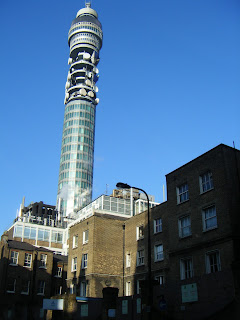
In the shadow of the BT tower

His salary is condemned as 'ridiculous' and the board of guardians in charge of the workhouse come under scathing attack for being 'utterly unconscious or wilfully neglectful of their duties as administrators of a great pauper hospital' and 'exact[ing] a fabulous and impossible task from their miserably underpaid surgeon'.

This report caused public outcry and was one of the major factors contributing to a parliamentary enquiry which ultimately led to the 1867 Metropolitan Poor Act. Under this a Metropolitan Asylum Board was set up, which regulated healthcare for the poor and established its own institutions to treat smallpox, TB and venereal diseases. This Act also oversaw the building of new hospitals and the introduction of professional nurses to all state institutions, and these reforms eventually led to the abolition of the Poor Law and - in 1929 - of the workhouse system itself. The NHS was established in 1948. 

You can read much more about the history of workhouses at an amazingly comprehensive website called workhouses.org.uk - this was an invaluable source in putting together this post.


Before we leave Cleveland St, there is one more interesting building we should visit. Nine doors down, at number 22, a rather famous author spent two periods of his life. This building, known then as 10 Norfolk St, was the first London residence of Charles Dickens, who lived here from the age of 3-5, after his family moved from Portsea, near Portsmouth in 1815, and again between 1829-31 when he was in his late teens. 

The second time Dickens lived on Cleveland St, during such a formative period of his life, must have had an impact on the young man's awakening social conscience. Dickens would have seen staff and inmates going in and out of the workhouse every day. It is thought that this might have been the building which inspired the workhouse in his most famous novel, Oliver Twist.

"Please, Sir... I want some more!"
Dickens' powerful empathy for the poor is not surprising considering how close he came to being institutionalised himself. The Dickens family were terribly poor, moving house constantly as Charles' father tried to find work and avoid creditors. In the first 21 years of his life Charles Dickens lived at 17 different addresses. His father was ultimately imprisoned in Marshalsea debtors' prison in Southwark and 11-year-old Charles was forced into child labour, sent to work in a blacking factory. This factory was within the Covent Garden parish and it is quite likely that some of his young colleagues had been apprenticed out from the Cleveland Street workhouse. 

After this, Dickens must have felt under constant threat of being sent to the workhouse - and in his Cleveland Street home he lived almost literally in its shadow. Small wonder his novels show such strong sympathy for the poorest members of society - Oliver Twist's fate could so easily have been his own.

Scholars debate whether this was indeed the workhouse that inspired Dickens' book but it seems an obvious candidate. The author certainly showed an interest in the institution in his later life; in the 1860s he corresponded with Dr Joseph Rogers, lending his support to the doctor's campaign to improve conditions there. In 1866 he wrote: 
"My knowledge of the general condition of the Sick Poor in workhouses is not of yesterday, nor are my efforts in my vocation to call merciful attention to it. Few anomalies in England are so horrible to me as the unchecked existence of many shameful sick wards for paupers, side by side with a constantly recurring expansion of conventional wonder that the poor should creep into corners to die, rather than fester and rot in such infamous places."
Number 22 Cleveland Street stands on the corner of the junction with Tottenham Street. It looks like the lower floor was recently used as a cafe but the shop is now empty with newspapers and whitewash plastered over the windows. It looks very sad and neglected. There is no blue plaque to say that this was the first London home of Charles Dickens - if you didn't know the significance of this building you could walk by without giving it a second glance.

But some signs of its 19th-century life can be seen; a lot of the original architectural features have survived, such as the projecting shop window and the semi-circular window above the front door. The upper storeys are also very typical with their dark brick and sash windows.

Having just given an impromptu history lecture to a group of men outside the King and Queen pub - who wanted to know why I was standing in front of a derelict building scribbling into a notebook - I think it is time to leave Cleveland Street. These men didn't know the significance of the old workhouse or the story of number 22 either - this really does seem to be one of Fitzrovia's best-kept secrets.